

How to Choose A Sankalpa for Yoga Nidra
You’re in a Yoga Nidra class. The teacher invites you to set your sankalpa. And your mind goes… completely blank.
If the only intention you can muster in that moment is “I will remember my shoes when I leave tonight” — you’re in good company.
Setting your sankalpa can feel unexpectedly difficult, not necessarily because it’s complicated, but because we’re not used to listening inward; quietly tuning in to what our heartfelt intention may be.
Whether you’re brand new to Yoga Nidra or you’ve been practicing for a while and just want to go a little deeper with your intention, here are some helpful guidelines.
What is Sankalpa?
Sankalpa is the Sanskrit word for intention, or resolve. What I love about the Sanskrit language is how descriptive it is, how many translations there are for just one word.
The word “san” can be translated as “a connection with highest truth,” and “kalpa” as “a vow above all others.”
One of my favorite interpretations is, “san” meaning “born from the heart”, and “kalpa” meaning “unfolding over time”. And that’s how you could view your intention. A heartfelt intention that unfolds over time through the practice of Yoga Nidra.
In Yoga Nidra, think of sankalpa as a seed. And the state of deep relaxation you enter during the meditation practice — that threshold between waking and sleep where the mind is open and unusually receptive — is like rich, fertile soil. Whatever you plant there has the best possible conditions to take root.
Another perspective, is to acknowledge that the seed of intention is already within you, an innate knowing of how you truly want to be, or how you want to live. And each time you practice Yoga Nidra, you’re watering and nourishing that seed through the deeply restful state of yogic sleep; watching it flourish, through your deliberate choices and actions in daily life.
What Sankalpa Is Not
It’s also important to be clear that sankalpa is not a tool for fixing yourself. It’s not about what’s wrong with you. If your sankalpa is, “I am happy and content”, that doesn’t imply that you are actually a deeply miserable and wretched person!
In the tradition of Sankalpa, the concept is that your essential nature is already whole and peaceful. When you state “I am happy and content,” you aren’t resolving to change a flawed version of yourself; you are nudging the subconscious to strip away the temporary layers of stress, habit, or distraction that cloud your natural state.
Sankalpa is also not a goal, like an impossible New Year’s Resolution. It’s a quiet signal to your deeper self — a vow between you and the truest part of who you are. When you create your sankalpa with an internal compass rather than an external expectation, you connect with what’s already true, or a longing to be true, at a level that is deeper than the thinking mind.
Sankalpa Types
Explore different ways to frame your intention, matching your current state of mind, or the specific focus of your upcoming Yoga Nidra practice.
Specific Sankalpas
These are clear, present-tense declarations. They speak something into being as if it’s already true. The doubting mind may not believe it yet. That’s okay. The deeper mind receives the messages anyway.
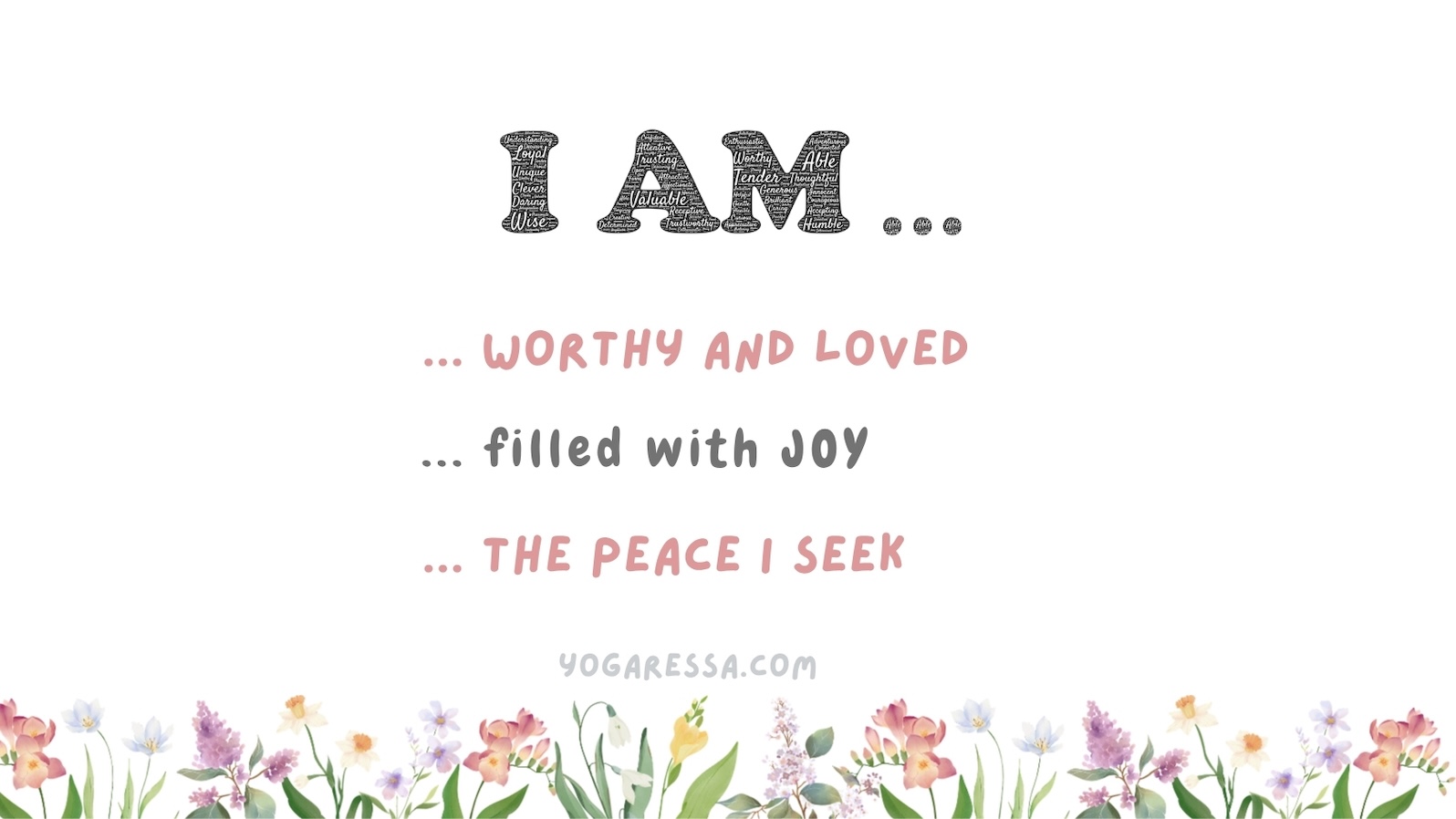
“I am worthy. I am valued. I belong here.”
“I move through life, confident and capable.”
“I have enough. I am enough. I am more than enough.”
“I am safe, secure, and protected.”
Statement sankalpas work well when you’re addressing a specific aspect of your emotions and beliefs — self-doubt, anxiety, a feeling of disconnection. They give shape and direction to your intention.
Broad Sankalpas
Some of the most powerful sankalpas are short, all-encompassing phrases — three words wide, yet three miles deep — vast enough to cover a multitude of other intentions.
“All is well.”
“I am present.”
Broader sankalpas are perfect for those days when you’re unsure of how to articulate something more complex. They ask nothing of you except to soften into the sensation. They meet you exactly where you are.
Lots of ways to explore Sankalpa — YouTube playlist here
How to Find Your Sankalpa
Your sankalpa already lives within you, as a heartfelt longing. The practice is simply one of listening.
Before your next Yoga Nidra session, try this:
Sit quietly for a moment. Take a breath. Without pressure or analysis, ask yourself:
“What do I most need right now?”
“How would I most like to BE, that would change everything?”
Notice the very first thing that surfaces — before your thinking mind steps in to edit or second-guess it. It might be a single word. It might be a phrase. It might be a feeling you can’t quite name but you can sense it.
Starting your intention statement with the words “I am …” or “I choose …” can anchor your wishes. For example, I am healthy, or I choose joy.
Simple Sankalpa Guidelines
Keep it positive. The subconscious mind responds to what you move toward, not what you leave behind. “I am calm” lands differently than “I am not anxious.” Frame your sankalpa with positive words, not words that convey lacking.
Keep it present tense. “I am” rather than “I will be.” The intention lives here, in this practice, right now.
Keep it simple. Resist the urge to nail Nirvana by throwing everything into one long declaration. “I am happy and healthy, blissfully filled with contentment and joy for all the loving people and abundant situations in my life…” tends to get a little lost. It’s almost as if the more words you use, the more diluted it becomes. “I am happy” is perfect. One breath. One seed.
Let it change. Your sankalpa may stay the same for weeks or months, or shift from practice to practice. What you need in one chapter of life may be different in the next. You don’t need to commit to a sankalpa forever. On the other hand, some people settle on one sankalpa for years, a constant compass that gets stronger with repetition. Both approaches are right.
From me to we. Ultimately, when your personal intention leads to a more balanced and grounded version of yourself, the benefits naturally ripple outward, enhancing your connections with others. This is when individual sankalpa evolves into meaningful contribution to the world around you.
How Intention Works in Yoga Nidra
When you silently state your sankalpa during Yoga Nidra — typically at the beginning and again at the end of the practice — the subconscious mind receives it as if it were already true. Even if the doubting mind questions it. The intention quietly takes hold beneath the surface.
During the meditation, you may also receive unexpected insights — a clearer sense of what occupies your mind, what your heart is asking for, what beliefs or habits are ready to change. This is part of the gift.
Sankalpa Repetition Is Not A Magic Wand
Yes, I happen to find Yoga Nidra a magical practice, with tremendous benefits, and I am convinced that repeating positive words of intention is much kinder and more useful than a constant stream of negative self-talk.
But the practice of Yoga Nidra truly depends when an affirmation is more than just something that you repeat until you (hopefully) believe it.
With regular practice, something begins to shift. You start making decisions and taking actions that naturally move you toward your sankalpa — with ease, aligning naturally with what mirrors your sankalpa. Each repetition, using the same words, nurtures and expands the intention a little further.
Inspiration for Sankalpa
Sometimes, listening to an affirmation meditation like this one, or reading a selection of intention statements, can be inspiration for finding or fine tuning your sankalpa.
Explore how you respond to the examples below:
HAPPY
I wake up today with joy in my heart.
I allow happiness into my life.
I celebrate my life.
PURPOSE
I live my life with meaning and purpose.
I am energized by my life’s purpose.
I am the architect of my life.
HEALTH
I make healthy choices every day.
I am healthy, at every level.
Every cell in my body is healthy and strong
HOPE
I am confident about the future.
I am a positive force, for myself and others.
My dreams and aspirations become reality.
SELF-LOVE
I love and accept myself, unconditionally.
I deserve happiness.
I am kind to myself.
Ready to Put It Into Practice?
If you’d like to experience sankalpa in practice, my Mini Nidra series on YouTube offers short 7-minute sessions, each built around a different intention — anxiety, self-worth, confidence, gratitude, love, clarity, and more. Each one is a small, complete world of its own. A gentle place to begin, or to return to, crafting your personal sankalpa journey.
May you be well. May you be happy.
May your intention, thoughts, words, and actions contribute in some way to a better world.
Om shantih.